
Francis Battah: Mutations (excerpt). Performed by Paramirabo
Francis Battah: Six Preludes, Prelude #4. Piano: Philippe Prud'homme
The "Portrait" series strives to highlight the people and organizations within the Percumedia client community.
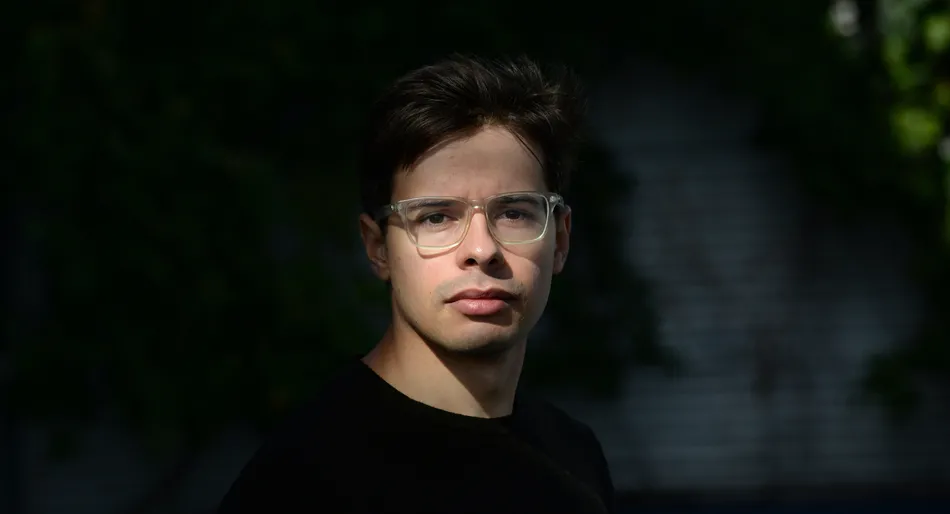
For this edition, we discover Francis Battah, a Quebec composer and professor at Cégep de Saint-Laurent.
A Quebec composer of a distinguished generation, Francis Battah holds composition degrees from the Université de Montréal and McGill University, where he studied with Denys Bouliane, Alan Belkin, Denis Gougeon and Ana Sokolović. His catalogue, comprising solo works, chamber music and orchestral pieces, has been commissioned by major ensembles and orchestras, including the Orchestre métropolitain, Quatuor Bozzini and Quasar, and presented at festivals in Quebec, Canada and Europe. Winner of a dozen competitions, including the 2021 SOCAN Grand Prize, several prizes at the Antonin Dvořák International Competition and a nomination for the 2025 Opus Awards as composer of the year, he is a grant recipient from the Canada Council for the Arts, the Conseil des arts et des lettres du Québec and the Conseil des arts de Montréal. His musical universe is inhabited by melody, micro-tonality and the idea of an imaginary folklore that forbids itself nothing—neither jazz, nor contemporary music, nor pure invention. Since 2023, he has been teaching ear training at Cégep de Saint-Laurent.
Some creators seek to anchor themselves in an existing tradition; others prefer to build one from scratch. Your journey seems to have naturally led you toward this second path—your works sometimes evoke entirely imagined musical cultures, with their own rules and their own sonorities. What brought you there? And concretely, what difference does it make, in the way you work, not having to "respect" a received heritage?
My journey, I believe, explains a lot. I didn't grow up musically in a conservatory with strict classical training. I learned music through pop and rock, leafing through the Beatles songbooks and other groups that my parents had at home. In high school, it was big band and school concert band, that's where I touched jazz for the first time, while taking private classical piano lessons in parallel.
Not inscribing myself in a tradition is therefore, in a certain way, staying true to myself.
All of that put together doesn't sketch out a very clear tradition. And honestly, I've never been able to fit into a specific movement. The creators I admire most are often precisely those who resist that label. Not inscribing myself in a tradition is therefore, in a certain way, staying true to myself.
What I love about the imaginary cultures approach is that it gives me a framework, but a framework that I build myself. And that framework allows me to put melody at the center of my work. In contemporary music, melody is often deliberately set aside, almost taboo. For me, it's exactly the opposite: sculpting sound through melody is a quest. Anchoring it in an invented folklore frees me to do it without having to justify myself.
You work with micro-intervals—those sounds that slip between the notes we've learned to recognize. How do you bring the audience, and even the performers, into this universe? Have you developed ways to make accessible what may seem, at first glance, disorienting?
Micro-tonality1, it's an immense field. It can be very conceptual and difficult to access, but it can also be surprisingly accessible, even popular. The group Angine de Poitrine is a good example: it proves that micro-tonality can reach an audience well beyond specialized circles.
It's a universe I've been exploring for about five years. But I want to clarify: I don't want to be labeled a "micro-tonal composer." It's one tool among others, which I use when it makes sense.
What interests me above all is the melodic dimension of micro-tonality, scales with non-tempered intervals2. My personal rule is simple: if I can sing a melody, even with a micro-interval, then the performers can too. That's my starting point.
Then, it all depends on who you're working with. I don't impose anything on musicians who don't have that practice. With Quatuor Bozzini, for example, who are really skilled in that area, we were able to go much further. And with digital keyboards, I found another way to explore that: the note is directly generated at the desired intonation, which bypasses the performer question. In all cases, what matters is that the result is heard and that it touches people.
There's an Italian expression, Traduttore, Traditore, "to translate is to betray," which you placed at the heart of one of your albums. It's a tension familiar to all those who attempt to create dialogue between different universes. In your work, what do you deliberately "betray," and in service of what?
This piece is connected to my master's project. At the time, language games attracted me in a somewhat intuitive way, I wanted to play with perceptions, with musical references.
And depending on each listener's background, the same music can be heard in completely distinct ways.
What I realized working on that is that my works draw from fragments of very different traditions. And depending on each listener's background, the same music can be heard in completely distinct ways. For example, in the first measures of my fourth prelude, a jazz musician will immediately recognize a blues progression. Someone rooted in contemporary music will rather hear timbre modeling3, acoustic spectra4. And a piano lover will simply feel dark and mysterious chords in the low register. All three readings are valid. I find that fascinating.
In Traduttore, Traditore, I also explored the idea of "passing" musical ideas through different scales. Through these transpositions, the ideas deform, alter, degrade a bit, like a translation that imperceptibly betrays the original. That's exactly the zone that interests me.
You were immersed in jazz before turning to contemporary composition—two universes that have their own values, their own codes, their own communities. How did you experience this passage? Do you still feel "between the two," or have you found your way to inhabit them together?
Jazz is part of my training, but I never practiced it professionally. I studied it at Cégep, I took courses at university, I listen to it, I'm interested in it. But I never felt that I had "migrated" from one milieu to another.
And especially, there was no bifurcation: when I was studying jazz, I was already doing composition. The two have always coexisted. I never felt sitting between two chairs, rather standing somewhere that belongs to me, nourished by several sources at once.
It's often said, in design, in architecture, in communication, that constraint is the mother of creativity. You've worked on commission for ensembles and orchestras, with imposed instrumentation, sometimes specific themes. Do you share this idea? Is there a particular commission that led you where you would never have gone without it?
Yes, honestly. I like constraints. And I like there to be expectations. Sometimes, their absence bothers me.
The commission that challenged me the most was a commission from SMCQ5 for drums, electric guitar, digital keyboard, video projection, saxophone and clarinet. I had never written for drums. Never for electric guitar. It was really stepping out of my comfort zone, and at the same time, it allowed me to concretize ideas I'd been hearing within me for a while.
What I find valuable is when expectations are clearly formulated. I think of someone like Denis Goujon, who succeeds remarkably well at this exercise: he knows who he's addressing, he adapts his language, and he responds exactly to what the performers expect. For me, he's a model.
What I would like is for performers to dare express their real needs more. Not on the aesthetic level, but on concrete questions: how much working time can they dedicate to the piece? Are we aiming for something directly accessible or something more experimental? For what audience? In what program? This information, when it's shared, changes everything—and avoids many disappointments.
In a few years, you've built a discography, won a dozen prizes, received commissions from major institutions, and you're barely thirty. In many fields, there's a pivotal moment between "building credibility" and "having the freedom to take risks." Do you feel you've reached that point? And what can you do now that you couldn't afford before?
I'm at a particular moment, yes, and not only professionally. I've been teaching full-time at Cégep de Saint-Laurent for a year and a half, which structures my life in a new way. And there's a credibility that has settled in, somewhat naturally, over time.
Winning a competition, in itself, doesn't change much. But winning several, with a bit of hindsight, I tell myself that it builds something real. At the same time, certain doors close too. Having a teaching position aligns life differently, and it's not always easy to embrace.
Right now, I would say I'm in a period of reflection. Last year was very intense, both in terms of creation and teaching. Now, I'm taking time to breathe, to ask myself what I really want to do, in what direction I want to orient my work. I'm happy to be established in the field. But now that I'm there, the challenge is to give meaning to what comes next.
Does teaching nourish your practice as a composer? How do you manage to reconcile these two activities that are, each in their own way, as demanding as the other?
I love teaching. It's always been part of who I am, it's not a fallback, it's a fully embraced choice, as central in my life as composition.
What teaching brings me is what composition cannot give me: daily human contact. Composing is solitary work. You live in your own universe, you meet the performers in rehearsal, the music is performed—but fundamentally, you're alone.
Teaching at Cégep is exactly the opposite. This session, I have about 85 students in ear training and theory, divided into small groups. I have a real relationship with each of them. Feeling that you're accompanying someone in their journey, that your presence matters, it's direct, concrete, human gratification. It's precious.
The two activities complement each other rather than oppose each other. But they each demand a lot. Finding balance is the work of a lifetime—and perhaps that too is a form of composition.
- 1
Microtonality is simply the use of "notes between the notes" — that is, intervals smaller than a semitone, or a tuning system that is not limited to the 12 notes of the piano.
- 2
A "scale with non-tempered intervals" is a scale in which the distances between notes are neither all equal nor governed by the system we know — the 12 equal semitones of the piano.
- 3
"Timbre modelling": ways of describing and recreating the timbre of a sound (the sound of a piano, a flute, a violin, etc.) using a model, often mathematical or computer-based.
- 4
"Acoustic spectra" refers to the way of representing a sound by showing which frequencies make it up and at what level each one is present.
- 5
Société de musique contemporaine du Québec.