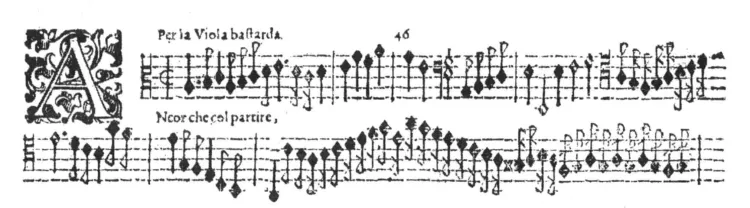
Sainte-Colombe: Three preludes in D minor: Prelude #1
The "Portrait" series strives to shine a light on the people and organizations within the Percumédia client community.
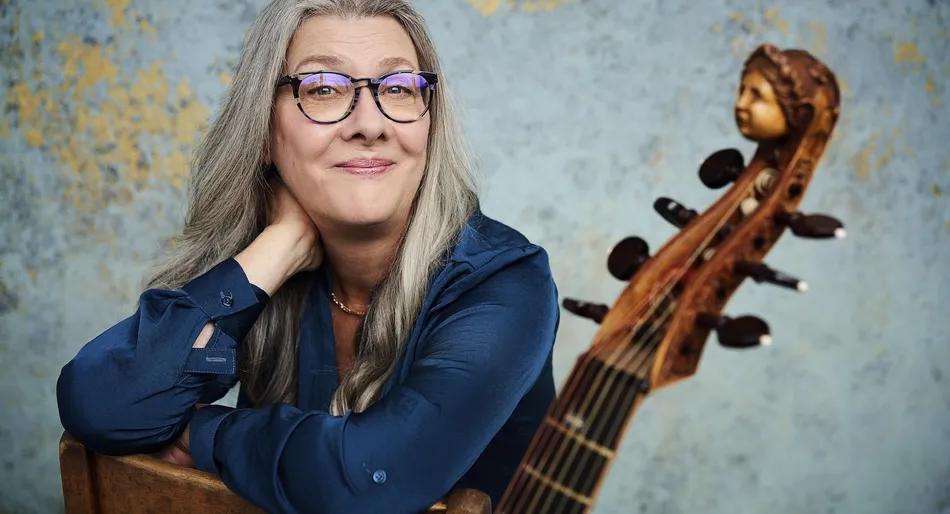
In this edition, Margaret Little is introduced — a virtuoso viola da gamba player and internationally acclaimed early music performer.
Margaret Little is a leading Quebec gambist, recognized both in Canada and internationally for the depth of her artistic commitment and the expressive clarity of her playing. Co-founder of the ensemble Les Voix humaines with Susie Napper in the 1990s, she has recorded more than a hundred albums — including some forty duo recordings — and has performed on major stages worldwide alongside renowned performers such as Jordi Savall and Wieland Kuijken, earning several prestigious awards along the way, including the Prix Opus and the Diapason d'Or. An active pedagogue, she has taught at Concordia University, Cégep Saint-Laurent, and the Université de Montréal, and continues to give masterclasses in Canada and abroad, thereby contributing to the training of the next generation of early music performers.
You describe yourself as a "messenger" who conveys stories and emotions. How does that work concretely when you play baroque repertoire, a world where the scores give so few indications at first glance? Was there a significant moment when you felt you had truly found your way of telling a piece?
Actually, baroque scores give fewer written indications, but they are far from silent! There's a whole set of performance conventions to learn, the rhetorical, harmonic, rhythmic discourse. It's a bit like arriving in a country whose customs you don't know: you first have to learn the codes to understand what's happening. My role is to make all that intelligible, to tell the story as well as possible so that someone listening can truly receive it.
And is there room for personality in that? Absolutely. If my way of telling a piece evolves, it's because I myself change. Each time I rework a piece, I discover new things. It's a bit like rereading a Tintin comic for the 500th time, there's always something new that emerges.
Your duo with Susie Napper within Les Voix humaines is a rare musical adventure: about forty records and decades of complicity. What has allowed this collaboration to last so long without running out of steam? And what has this relationship taught you about yourself as a musician?
My God, what a beautiful adventure! The pinnacle, for me, was recording the 67 concerts for two equal violas by Sainte-Colombe. It was an extraordinary experience, a bit like visiting an exhibition entirely devoted to Rembrandt, for example. At a certain point, you truly enter the painter's universe, you understand things that a single painting could never have revealed to you. With Sainte-Colombe, it was the same.
And after a certain time, in concert, I could anticipate what was going to happen in Susie's brain. That's the magic of live music.
What's fascinating in the duo is that we're not only telling something together, what we say depends on what the other is saying. It's a living dialogue, in real time. We've even been compared to trapeze acrobats catching each other in flight. And after a certain time, in concert, I could anticipate what was going to happen in Susie's brain. That's the magic of live music.
You play on a seven-string bass viola made in Paris in 1982 by Judith Kraft and Bernard Prunier, with bows by Quebec luthier Louis Bégin. How would you describe your relationship with this instrument? Do you ever feel a tension between the demands of a period instrument and those of playing today?
The first thing to say is that in the baroque era, people often played on new instruments. So historically, it's entirely coherent that I started playing on this viola from the time it was made. It's now been 43 years that we've been together, and we've truly grown with each other.
A quality instrument is alive. When I lend my viola to someone for a concert and they return it to me a few days later, it no longer sounds quite the same. The person has sought other resonances, brought out other things. It's a bit like leaving your child at your sister's for the weekend, when you return, they've slightly changed.
And we ourselves are vibrating beings made of molecules that vibrate in reaction to what we perceive. An instrument is the same. It reacts to humidity, atmospheric pressure, everything around it. It's always in movement, in flux.
You've taught viola at Concordia University, Cégep Saint-Laurent and the University of Montreal, in addition to giving masterclasses on several continents. What has teaching brought you that the stage alone couldn't have given? And how does one transmit something as subtle as the "good taste" that ancient treatises speak of?
Whether with young professionals in training or with amateurs, it always comes back to what I call "awareness." Playing an instrument is playing oneself. It's not the viol that will improve if you practice: it's yourself.
What fascinates me in teaching is finding the right words to awaken this awareness in the other person and thus allow them more technical ease. Because technique, ultimately, is always in service of something: having more freedom to tell what you want to tell.
Playing an instrument is playing oneself. It's not the viola that will improve if you practice: it's yourself.
There's also transmission through osmosis, which comes when you play with the person, letting things occur without naming them. And depending on each person's needs, the approach changes: faced with someone very intellectual, we'll work on the sensorial; faced with someone very intuitive, we'll rather build reference points, the tactus1, the architecture.
I still teach at the Cammac Music Centre, where I myself discovered the viola da gamba at age 11. I give a course there for advanced amateurs, and those moments are precious. When a group achieves a chord where the color is truly beautiful, everyone feels elevated.
I should say that the word "amateur" deserves to be rehabilitated. In the baroque era, an amateur could be as competent as a professional. They simply didn't earn their living from it. And musical practice as an amateur brings a great deal: it creates connections, synchronizes brains: we know that in a choir, the brain regions of singers actually synchronize. Making music is profoundly human.
Your collaboration with dancer Stéphanie Brochard in the show Atempor/elle took you into quite different territory from your usual work. What attracted you to this dialogue between music and body? And did this experience change anything in your approach to early music?
I had already worked with baroque dancers, but this was pure creation. We were searching, trying things, I was participating in the staging, I was myself a character in the show. And one of the great challenges, which I really appreciated, was learning all of it by heart.
In baroque music, playing from memory isn't really a tradition. Most of the time, we play chamber music with continuo, and we have the score in front of us. So learning an entire piece by heart was a new experience. It certainly had an effect on my practice. During the pandemic, Christophe Gauthier and I decided to learn Bach's third sonata by heart. Playing from memory as a duo was truly striking.
The viola da gamba remains relatively unknown to the general public, even though it has aroused growing interest for several decades. What are, in your view, the most important challenges and opportunities for this instrument in Quebec and Canada today? And how do you imagine the next generation of violists?
Sometimes, as a performer, I feel like an endangered species, not because the viola is disappearing, but because I truly don't know what the place of live acoustic music will be in 50 years. In Montreal, there have been very flourishing periods. Today, interesting things are still happening, but differently.
What I observe among young people is an interest in more specialized practices: singing while accompanying oneself on the viola, exploring medieval music, opening up to Middle Eastern music. It's exciting.
In France, the viola da gamba is taught in regional conservatories from age 5. We see young people of 15 arriving who have already played almost all of Marin Marais's work. The language of this music has been part of their lives since childhood. Here, we generally come to the viola later.
Tomorrow afternoon, in fact, we're going to play consort2 at my place, for pleasure. Andrew Goodlett will be there, double bassist with the OSM, who also plays viola da gamba very well as an amateur. That's exactly it, the living reality of this instrument: musicians from all backgrounds who find themselves there, out of love for the sound and the repertoire.