What if your website was also a statement of values?
You manage a cultural organization, a charity, a small business. You don't have an army of technicians behind you. But you regularly make decisions that commit your digital presence for several years: which tool to choose for your website? Which platform to manage your members? Which service for your newsletters?
These decisions seem technical. They're not really. They're strategic decisions and they deserve to be approached as such.
"Free software" or "open source": what does it mean for me?
Let's start by demystifying the concept, because the term is often scary or, conversely, misunderstood.
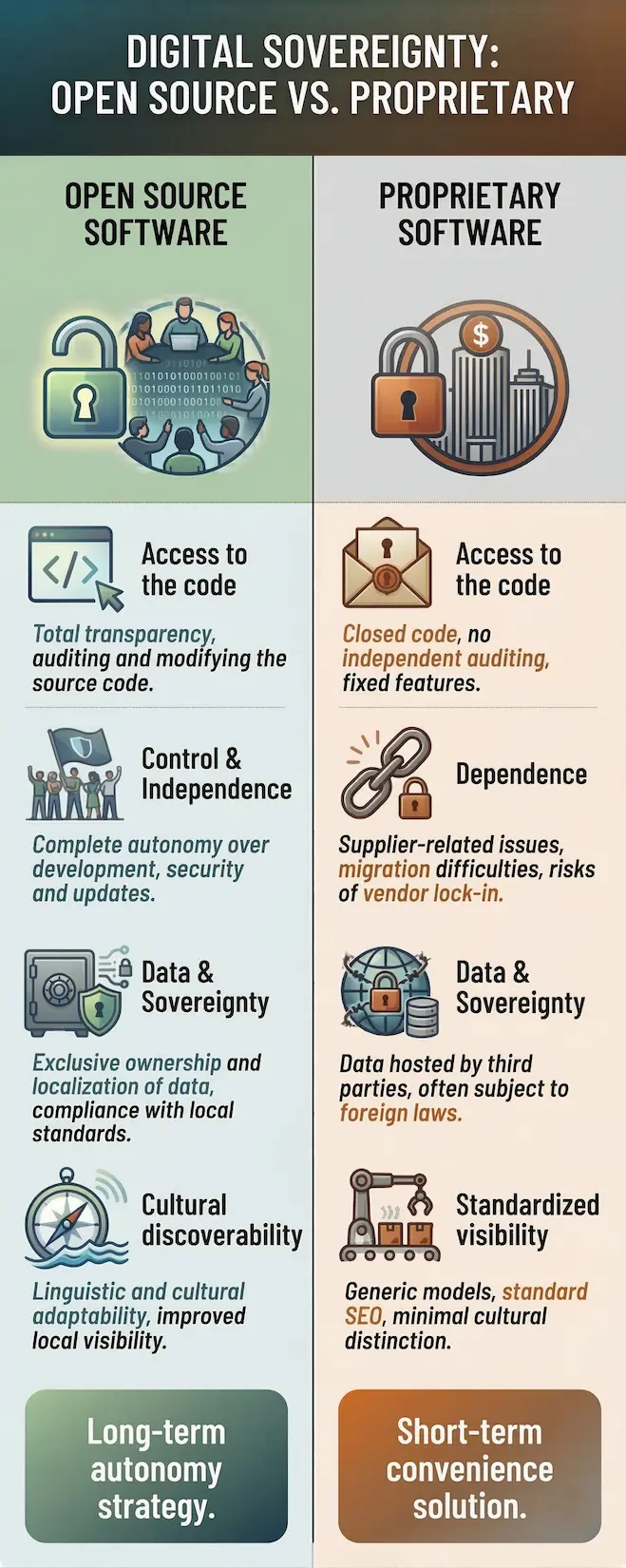
Open source software is software whose "source code" — the recipe, so to speak — is accessible to everyone. Anyone can examine it, improve it, adapt it. And most importantly, these improvements go back to the entire community. No one can appropriate the software to turn it into a closed and paid product.
In contrast, proprietary software belongs to a company. You don't buy the software, you buy the right to use it, according to conditions that the company sets, and which can change overnight.
The distinction is important. Not for technical reasons, but for very concrete reasons: who decides? who controls? and how far does your autonomy go?
Dependency, that silent trap
Here's a scenario that many organizations have experienced. You choose a popular proprietary platform to manage your site or your members. It works well for two or three years. Then the company behind the platform is acquired. Or it decides to change its pricing model. Or it abandons the functionality you depend on. Or, in the worst case, it shuts down.
And then, you're stuck. Your data is held hostage in a format you don't control. Everything you've built depends on a decision you didn't make and don't control.
This is one of the most underestimated risks in the digital choices of small and medium-sized organizations.
With an open source tool, the situation is fundamentally different. The software doesn't belong to anyone in particular: it belongs to its community. You can change web agencies without starting over. You can migrate your hosting. You can adapt the tool to your needs without asking anyone's permission. Your digital presence truly belongs to you.
When the UN chooses open sourceIn June 2025, the United Nations held its first Open Source Week in New York, a week of meetings between governments, international organizations and free software communities from around the world. Drupal, the platform on which Percumédia builds its projects, was present. Not as an observer: as an example. Because Drupal embodies exactly what the UN seeks to encourage, an active community in more than 150 countries, without a dominant player, which no one can seize to turn into a closed commercial product. What emerged from this event is telling: open source is no longer perceived as an alternative technical choice. It has become a question of governance. More and more governments are openly asking the question: if public funds finance the development of a digital tool, shouldn't this code belong to everyone? For cultural, community organizations and small businesses, the logic is the same. What you build with your limited budget should belong to you, and be able to serve you for a long time. |
Digital sovereignty: taking back control of what belongs to us
This is the subject we're talking about more and more in Quebec and Canada, and for good reasons.
Ask yourself this question: do you really know where your data lives? Information about your members, your donors, your customers, your transactions — on which servers are they located? In which country? Under which laws?
If you use services provided by large American companies, which is often the case, even without realizing it, there are American laws that allow authorities to access this data, even if the servers are physically in Quebec. This is not an alarmist hypothesis: it's a legal reality that many organizations discover a bit late.
For a charity that protects the confidentiality of its beneficiaries, for a small business whose customer data is its most precious asset, for an entrepreneur who builds their reputation on trust or for a cultural organization that manages irreplaceable archives, the question is not abstract, it's very concrete.
There is also a legal obligation not to be overlooked: Law 25, fully in force in Quebec, requires any organization that collects personal data to obtain clear consent, inform people of their rights and be able to return their data to them upon request. Breaches can result in significant fines.
Open source doesn't fix everything with a magic wand. But it creates the conditions for a possible response: choosing a Quebec or Canadian host, knowing exactly what the software you use does, keeping control over your data rather than delegating it to a foreign platform.
Digital sovereignty is not a concept reserved for governments. It's a decision that every organization can make, one infrastructure at a time.
For organizations: a question of digital survival
If you run a musical ensemble, a festival, a gallery or a community organization, you face a particular challenge: how will your content, in French, in a specific cultural context, be found in a digital environment that massively favors English and large productions?
The answer doesn't lie in large advertising budgets. It lies in the quality of your digital presence: a well-structured site, well-organized information, content that search engines and artificial intelligence systems can read and value correctly.
Open source platforms are built on shared and open standards, which means they are better equipped to speak the language of the modern web. For a Quebec cultural organization, this is a real advantage. Open source, here, is not just an economic choice. It's a discoverability strategy.
"But will it be easy to use?"
This is often the first question we're asked, and it's the right one.
Free software can be technically powerful and remain difficult to use on a daily basis if no one has taken the time to adapt it to your real needs. This is where the work of an agency like Percumédia comes in.
Our role is not to deliver raw software to you and wish you good luck. It's to build, on top of a robust and proven platform like Drupal, an interface tailored to your reality: your way of publishing content, your vocabulary, your workflow. The content editor who opens your site on Tuesday morning should never have to think about the technology running behind it — they should just be able to do their job, simply and efficiently.
This is precisely what open source makes possible: a solid foundation, built by a global community, on which we can build a customized experience, without starting from scratch each time and, significantly, without paying usage licenses that climb every year.
A choice that says something about you
Ultimately, choosing open source software for your organization says something about your values.
It's choosing transparency over opacit, autonomy over dependency, sustainability over short-term convenience. And in many cases, it's choosing to circulate your resources confidentially and securely in a community ecosystem rather than concentrating them in the pockets of a shareholder somewhere on the other side of the continent.
For organizations whose mission is to serve the common good, culture, community, responsible entrepreneurship, there is something deeply coherent about building on foundations that share these same values.
What it changes, concretely, for you
You don't need to understand how software works to make the right choice. You need a partner who understands these issues on your behalf and can guide you with clarity.
At Percumédia, this is exactly what we've been doing since 2017. We build digital presences that truly belong to our clients — robust, scalable, user-friendly, free from any imposed dependency.
Because your mission deserves tools worthy of it.
Do you have questions about your current digital tools or about what a free software site could change for you? Let's talk about it, we love these conversations.